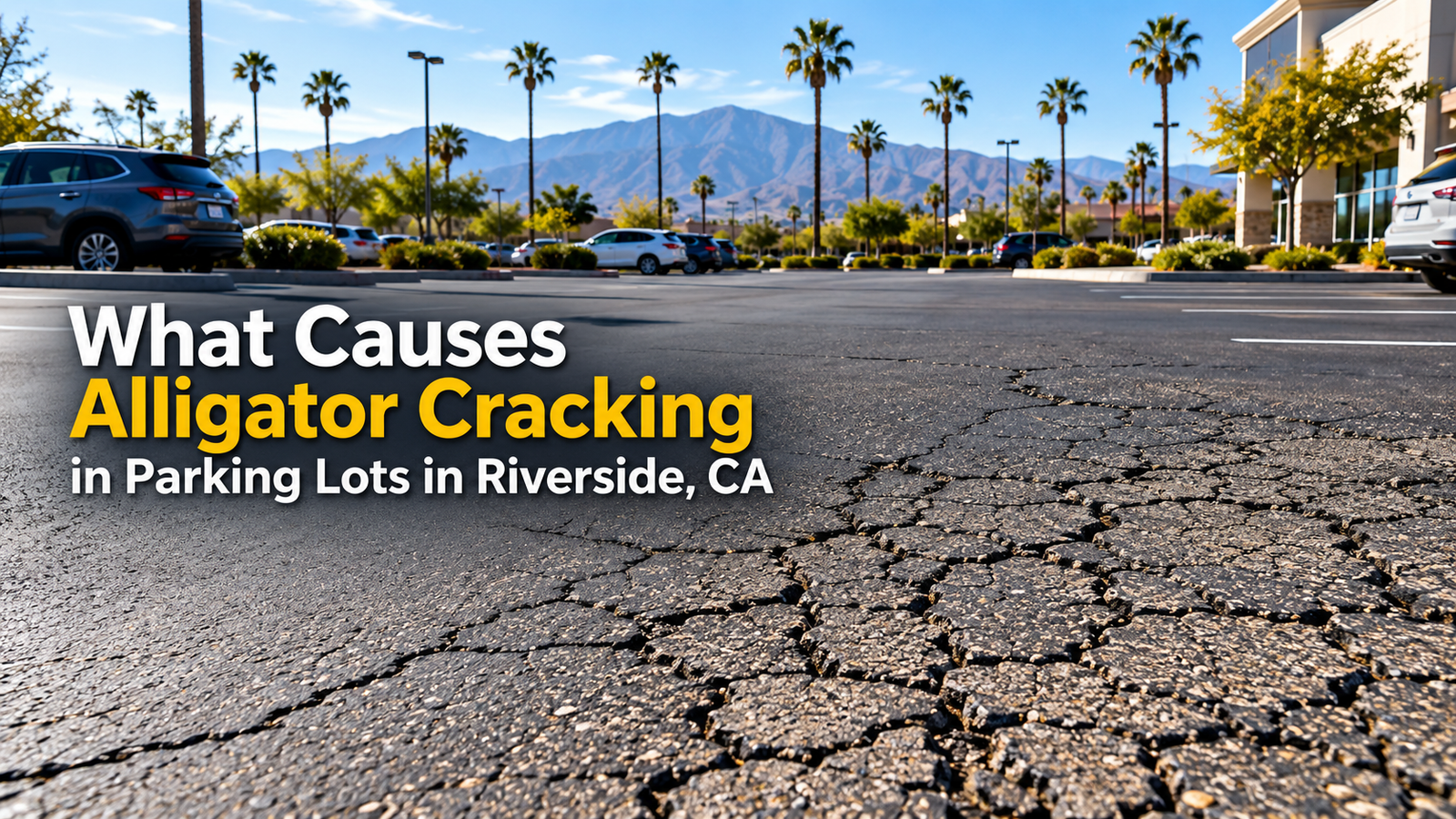
Alligator cracking the interlocked pattern of Crack Parking Lot Riverside that divides a parking lot surface into irregular polygons resembling an alligator’s skin is the most definitive sign of structural pavement failure. Its presence in a Riverside parking lot means that the failure has progressed beyond what surface maintenance can address. Understanding what causes it, how it develops over time, and what distinguishes alligator cracking from other pavement distress patterns helps parking lot owners make informed decisions about when patching is adequate and when a more comprehensive repair strategy is necessary.
In Riverside and the broader Inland Empire, alligator cracking has specific causes that are tied to the region’s climate, native soils, and the traffic patterns of Southern California’s commercial and industrial landscape. The process is the same wherever flexible asphalt pavement is used, but the speed of progression and the specific triggering conditions differ from those in more moderate climates.
The Mechanics of Alligator Crack Formation
Alligator cracking is a fatigue failure. It begins at the bottom of the asphalt layer not at the surface and propagates upward. Understanding this bottom-up initiation is essential for understanding why alligator cracking cannot be fixed from the top down.
When a vehicle wheel passes over asphalt pavement, the pavement flexes downward under the load. The bottom of the asphalt layer goes into tension as it stretches around the deflected area. With each wheel pass, the asphalt is stretched in tension, and over hundreds of thousands of load repetitions, the accumulated tensile damage initiates micro-cracks at the bottom of the layer. These micro-cracks are invisible at the surface in their early stages the pavement above them is still intact.
As the micro-cracks coalesce and grow, they propagate upward through the asphalt layer. Once they reach the surface, they appear as disconnected short cracks. With continued loading, the cracks interconnect, forming the characteristic polygon pattern. The small polygons near the center of heavily loaded areas are the most advanced stage at this point the asphalt pieces within the pattern are loose and rock individually under load, actively accelerating the failure. The pavement is now close to pothole formation.
Causes Specific to Riverside Parking Lots
The underlying cause of alligator cracking in any parking lot is one or more of three conditions: the structural section is too thin for the loads applied, the subgrade bearing capacity is lower than the pavement design assumed, or both simultaneously. In Riverside, each of these conditions has specific drivers.
Thin structural sections are common in Riverside’s older commercial parking lots, many of which were built in the 1970s and 1980s to design standards that are considered inadequate by current practice. Traffic volumes on many commercial corridors have increased substantially since original construction, and delivery vehicle sizes and axle loads have grown. A parking lot built for the traffic of 1980 may have an entirely inadequate structural section for the traffic of the 2020s.
Subgrade weakness in Riverside is associated with the valley’s alluvial and fan deposits. The Santa Ana River alluvial fan, which underlies much of western Riverside County, includes fine-grained sandy clays and silty soils that are moderately expansive and lose bearing capacity significantly when saturated. Parking lots built on this subgrade without adequate base thickness or drainage provisions can experience subgrade softening every winter wet season, and the cumulative effect of repeated weakening and recovery produces progressive subgrade deterioration that manifests eventually as alligator cracking.
The Role of Water in Alligator Cracking in Riverside Parking Lots
Water is the accelerant for alligator cracking in Riverside. Without water, a parking lot with a marginally thin structural section might last 20 or 25 years before fatigue failure becomes visible. With water infiltration from cracked surfaces and lateral migration from poorly drained edges or adjacent irrigation, the same lot may show alligator cracking in 8 to 10 years.
The sequence is straightforward: surface oxidation produces cracks, cracks allow winter rain and year-round irrigation water to reach the aggregate base and subgrade, saturated soils lose bearing capacity, the pavement deflects more under each vehicle load, and the fatigue damage accumulates faster. Each winter wet season advances the deterioration further. Commercial properties with irrigation systems that keep the soil adjacent to the parking lot continuously moist a common situation in Riverside’s manicured commercial properties may experience this accelerated sequence regardless of rainfall levels.
Areas of a parking lot that have concentrated water flow low points, areas adjacent to downspouts, zones near blocked or inadequate drainage inlets consistently show alligator cracking first and most severely. These patterns are diagnostically useful: they confirm the water-subgrade-fatigue mechanism and identify where drainage improvements should be incorporated into any repair strategy.
How Alligator Cracking Differs from Other Parking Lot Crack Patterns
The interconnected polygon pattern of alligator cracking is distinct from the other crack patterns that appear in Riverside parking lots. Block cracking produces larger rectangles distributed across the surface and results from binder hardening, not subgrade failure. Transverse cracking produces parallel lines perpendicular to the driveway direction from thermal contraction. Longitudinal cracking produces single or parallel lines running in the direction of traffic.
The critical distinction is between surface-initiated cracks (block cracking, transverse cracking, longitudinal cracking from edge conditions) and load-initiated cracks that originate in the structural section (alligator cracking, longitudinal cracking from fatigue). Surface cracks can be managed with crack sealing and sealcoating if caught early. Load-initiated structural cracks require base repair. Misidentifying alligator cracking as surface cracking and treating it with sealcoating is a common and costly error the sealcoat application masks the crack pattern temporarily while the underlying structural failure continues uninterrupted.
Repair Approaches for Alligator-Cracked Areas in Riverside Parking Lots
Repair of alligator-cracked areas in Riverside parking lots requires removing the failed material both the cracked asphalt and the weakened base and rebuilding the structural section from the subgrade up. The repair depth is determined by the depth of the structural failure: if only the asphalt has failed and the base is still sound, a base course and surface course replacement is adequate. If the subgrade itself has been destabilized by repeated water infiltration, base replacement is insufficient without also addressing the subgrade condition.
In-place recycling is a cost-effective approach for Riverside parking lots with widespread alligator cracking. Full-depth reclamation uses a reclaimer machine to pulverize the existing asphalt and aggregate base together and re-blend them into a new stabilized base layer. This approach recycles 100 percent of the existing pavement material in place and reduces the cost and truck traffic associated with hauling and replacing material. The reclaimed base is compacted and overlaid with new asphalt surface course. For parking lots where the structural section is uniformly inadequate rather than locally failed, full-depth reclamation is often the most cost-effective rehabilitation strategy.
Frequently Asked Questions: Alligator Cracking in Riverside Parking Lots
Can alligator cracking be repaired with sealcoating?
No. Sealcoating is a surface treatment that cannot address the structural failure that causes alligator cracking. Sealcoat applied over alligator-cracked areas will crack through at the same locations within one season because the underlying movement continues.
Does alligator cracking always indicate total pavement failure?
Not always total failure, but always structural failure a problem in the base or subgrade, not just the surface. The extent of the alligator-cracked area and the size of the individual crack polygons indicate how advanced the failure is. Small polygons in the crack pattern indicate the most advanced stage.
Why does alligator cracking appear in some areas of a Riverside parking lot but not others?
Alligator cracking concentrates where the structural section is thinnest, the subgrade weakest, or water infiltration greatest. Low spots, areas near drainage obstructions, and zones adjacent to irrigation are typical cluster locations. These patterns are diagnostically valuable for repair planning.
How is alligator cracking different from block cracking?
Block cracking produces large rectangular polygons across the surface from binder hardening and is not a structural problem. Alligator cracking produces small interconnected polygons in trafficked areas and indicates base or subgrade failure. The two require completely different responses.
What is full-depth reclamation and when is it used in Riverside?
Full-depth reclamation pulverizes the existing pavement and base together, creating a new blended base layer in place. It is used when alligator cracking is widespread across a parking lot, making it more cost-effective to rehabilitate the entire structure than to patch individual failed areas.
Alligator cracking in Riverside parking lots is the surface expression of a structural problem that developed over years below the visible surface. Identifying it correctly, understanding its cause in the specific context of Riverside’s soils, climate, and traffic, and applying the appropriate repair strategy not a surface treatment, but a structural fix is the approach that produces durable results in the demanding environment of Southern California’s Inland Empire.